Wednesday, May 1, 2013

Breaking the Fourth Wall: Week of May 1


"Breaking the Fourth Wall" is our weekly series that directs the blog's spotlight toward a particularly innovate or promising affordable housing project, luminary, or organization. 

Image Credit: Design Philadelphia 
Today we highlight a Philadelphia micro-house initiative that promises to combine the elusive goals of substantiality, affordability, and bold design. The New Kensington Community Development Corporation (NKCDC) has already undertaken a Neighborhood Stabilization Program throughout the Kensington, Fishtown, and Port Richmond neighborhoods and plans to turn the area's proliferation of vacant lots into an opportunity for affordable housing that prizes efficiency and cost effectiveness. The "weeHouse" proposal involves placing affordable, attractive, and environmentally-friendly modular homes whose "stick built construction are efficient in quantity" on these empty parcels in an attempt to make more affordable housing available in Philadelphia. Unlike many other proposals, weeHouse grew in part out of challenges posed to architects to expand the scope of modular home design to include stylish and green construction while making good use of vacant urban land and meeting government affordable housing objectives. The plans for the modular homes, still in the theoretical phase, run contrary to the notions that affordable housing must be unattractive and unwieldy- in contrast, they are beautifully conceptualized by teams at Alchemy Architects, leave a green footprint, and can be constructed for an estimated 20% less than comparable projects, plus reduced financing and long-term energy costs. While the plans to build clusters of these affordable are not yet funded, their potential application in vacant lots throughout Philadelphia, innovative design features, cost saving possibilities, and NKCD's impressive track record of forming successful partnerships with public and private organizations including the Philadelphia Redevelopment Authority, design and architecture firms, and affordable housing development agencies like Diamond & Associates suggest a big future for these small and inventive affordable dwellings. 

Monday, April 29, 2013

Geographic Apartheid and the Homeless in Detroit

In recent weeks, some troubling accusations have been leveled against the city of Detroit's police force. The ACLU of Michigan alleges that the Detroit Police Department (DPD) is forcing the city's homeless who congregate in popular tourist neighborhoods into vans and bringing them to East Detroit and points outside the city limits in the hopes that they will have a difficult time returning to the popular destinations. These allegations are the latest in a series of "homeless dumping" concerns raised in Detroit and follow on the footsteps of controversial efforts in cities like New York to send the homeless out of the city by buying individuals and families one-way tickets to faraway cities where they can stay with relatives.

Image Credit: Wikimedia Commons 
At the center of the news of the disturbing treatment of Detroit's homeless population is a kernel of good news that may surprise the naysayers and connoisseurs of Detroit "ruin porn." This good news is related to tangible economic development and rejuvenation efforts in Detroit, particularly in the Greektown and Midtown neighborhoods, where both prosperous locals and tourists flock to galleries, trendy restaurants, and entertainment venues like the Greektown Casino. However, this nascent Detroit renaissance has come at the expense of those most in need in a city where hundreds of thousands of residents remain unemployed or underemployed and in need of livable, affordable housing. Quinn Klinefelter of WDET Radio in Detroit recently spoke with NPR's Celeste Headlee and provided more detail about the allegations, including claims that the DPD made homeless Detroiters empty their pockets of bus fare to prevent them from quickly returning to Greektown along routes that avoid many of the Detroit neighborhoods where panhandlers might be easy targets for robbery.

The DPD and U.S. Attorney's Office have stated that they have not yet received a copy of the specific allegation made by the ACLU to the Justice Department and will not respond to the allegations until they have more information. In the meantime the ACLU's allegation of "homeless dumping", in addition to raising questions about violations of Fourth and Sixth Amendment rights, present a startling example of what can happen when gentrification is predicated on the disenfranchisement of some of most vulnerable sectors of society and presents an opportunity to turn away from these practices and implement policies that encourage economic development and the renewed urban activity in urban cores like Detroit while meeting the demand for affordable housing units. These policies would better ensure that renewed urban fortunes can be enjoyed by a wider portion of the population and break away from the forcible separation of the homeless from the rest of the city in a geographic apartheid that amounts to mistreatment and violation of basic dues process rights and protection from unwarranted search and seizure.

Sunday, April 28, 2013

The Bridge and Tunnel Fair Housing Battle Continues in Westchester

Image Credit: Ant-Discrimination Ctr. of Metro N.Y. 
The state of fair housing in high-income areas has been the subject of several posts on this blog (and much coverage in the Times' Real Estate section) and, this week, Westchester County, home to many well-heeled New York suburbs as well as low-income cities like Yonkers, came under judicial and administrative scrutiny for failure to comply with previous orders to prohibit housing discrimination based on sources of income. In 2009, a federal court mandated that Westchester County would undertake the construction of more than 750 affordable housing units in largely white and affluent communities (similar to the Montgomery County, Md. model, though on a smaller scale) and market them to minority and low and moderate-income tenants living in other parts of the county and the region, thus attempting to address the county's pattern of de facto racial and economic segregation. See U.S. ex rel. Anti-Discrimination Ctr. of Metro N.Y., Inc. v. Westchester Cnty., 668 F.Supp.2d 548 (S.D.N.Y. 2009). While county officials claim that they have taken considerable steps toward the construction of such housing, HUD spokespeople claim that the district court's decision, upheld by the Second Circuit Court of Appeals last month, obliges the county to put in place mechanisms to prevent housing discrimination based on sources of income, including Section 8 vouchers, alimony, and child support. See U.S. ex rel. Anti-Discrimination Ctr. of Metro N.Y., Inc. v. Westchester Cnty., No. 12-2047 (2d Cir. Apr. 5, 2013). Citing the County Executive's 2010 veto of the Board of Legislature's ban on income-based housing discrimination and the county's lack of meaningful review of its fair housing ordinances, the U.S. Attorney for the Southern District of New York's office stated that Westchester was not in compliance with previous orders and placed a deadline of this week to reintroduce legislature banning source-of-income housing discrimination. Additionally, HUD has threatened the revocation of more than $7M in funds allocated to Westchester County if the county does not comply with these measures. Last week, the Board of Legislatures voted to further challenge the lawsuit but the County Exceutive's recent statement that he would sign the anti-discrimination bill he previously vetoed if the legislature passes it again and strong statements in favor of more inclusive housing policies from many Westchester residents point toward a possible bright spot on the long road toward income-based house fairness in many of the nation's more affluent municipalities.

Friday, April 26, 2013

When Nuisance Laws Become a Menace

The law of nuisance has emerged over the centuries to govern relationships between neighbors and community members who have contractual obligation to each other. The most common contemporary nuisance laws, usually enacted in the form of local ordinances, regulate conduct that is not usually illegal but, if it exerts harm that outweighs its social utility and is unsuitable to the area in which the conduct occurs, can constitute an undesirable burden on the community. Factors such as the nature of the conduct (e.g. intentional or unintentional), character of the harm (the level of danger posed to the community), and the cost to both the plaintiff and defendant in avoiding the harm have been incorporated into analyses of nuisance complaints. See Page Cnty. Appliance Ctr., Inc. v. Honeywell, 347 N.W.2d 171 (Iowa 1984). Examples of such conduct range from loud noises and unruly gatherings in residential areas to agricultural and chemical waste. See e.g. Art. 40, Amherst, Mass. Home Rule Auth. Bylaws (2008); KOC 830.6 (2008). Ordinances that enforce the limits of nuisances, particularly in residential communities, work toward the goal of encouraging neighbors to get along,  foster respect, and prevent excessive litigation.

Image Credit: Wikimedia Commons 
However, a host of nuisance laws across the country have been challenged for violating residents' civil and constitutional rights, including protections enumerated in the Fair Housing Act. A particular example of these distressing nuisance laws that has recently attracted a flurry of media attention is the "disorderly behavior ordinance" in Norristown, Pa., a borough near Philadelphia. According the ACLU, the borough "penalizes landlords and tenants when the police respond to three instances of 'disorderly behavior', including domestic disturbances, within a four-month period." After these "three strikes" of police response to domestic disturbances, landlords are pressured by the borough to evict the tenant and, in some cases, have threatened to condemn properties and forcibly remove tenants if they are not evicted. Such threats have led many victims of domestic violence, including named plaintiff Lakisha Briggs, was threatened with eviction after she and various neighbors reporting her ex-boyfriend's violent behavior to police, to remain silent and refrain from reporting instances of abuse to authorities in fear of eviction. Although Norristown agreed to repeal the disorderly behavior ordinance, the borough subsequently passed an ordinance that outlines fines that can be placed on landlords who do not evict tenants who call for police assistance, including for instances of domestic violence that "do not require a mandatory arrest to be made." Borough of Norristown Code §245-3 (2013).

The sense of fear and helplessness that these ordinances impose on victims of domestic abuse, in addition to violating tenants' First Amendement rights and the Violence Against Women Act (VAWA), may also present violations of the Fair Housing Act under the still-debated disparate impact theory. The Act prohibits housing discrimination on the basis of "race, color, religion, sex, national origin, physical ability, or familial status" with limited exceptions and, as studies show that women and persons of color are victims of domestic violence more often than other populations, housing discrimination against domestic violence victims would disproportionately affect female tenants and tenants of color and thus constitute unlawful housing practices under a theory of disparate impact. While SCOTUS has not yet ruled on whether fair housing discrimination claims can be properly brought on disparate impact grounds, the Third Circuit Court of Appeals, which covers Pennsylvania, along with the other federal circuits have allowed disparate impact fair housing claims to be brought. Indeed, the case which prompted SCOTUS' recent invitation to the Solicitor General to express the views of the U.S. regarding disparate impacts on housing was a Third Circuit decision to allow disparate impact claims. See Mt. Holly Gardens Citizens in Action, Inc. v. Twp. of Mt. Holly, 658 F.3d 375 (3d Cir. 2011). Disparate impact theory presents an opportuity to add cognizable housing discrimination claim to the VAWA and First Amendment claims that are likely to be filed in opposition to these "disorderly behavior" ordinances. 

Tuesday, April 23, 2013

Breaking the Fourth Wall #1: Week of April 23

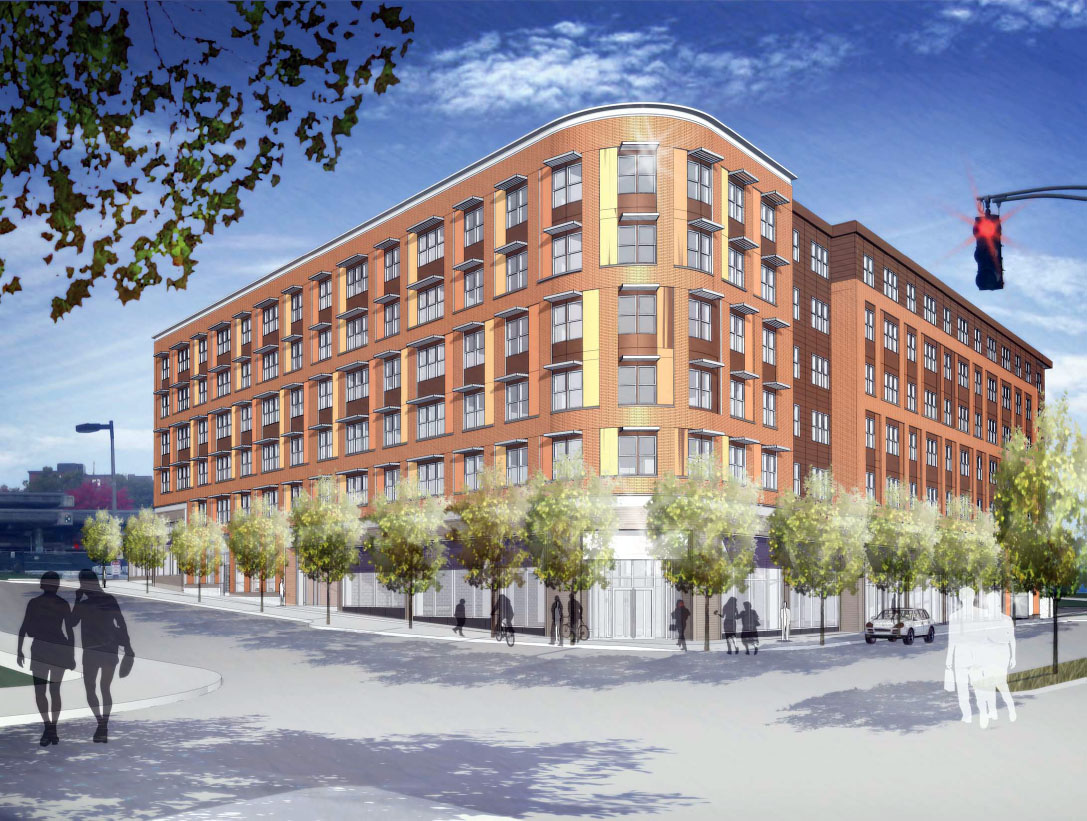
Image Credit: The Community Builders, Inc.
This is the inaugural post in this blog's weekly series entitled "Breaking the Fourth Wall", an endeavor to direct the spotlight toward a particularly innovative or promising affordable housing project, luminary, or organization. In light of the beautiful resiliency shown by 4Walls1Blog's hometown of Boston in the wake of last week's horrific bombings and subsequent manhunt and shootout, we begin our series in Boston- a city long recognized as a bastion of diversity, tolerance, and progressive affordable housing policies- with the 225 Centre/Jackson Square project.

The 225 Centre Street project represents the first building in a $250M redevelopment plan featuring fourteen-buildings in the Jackson Square area of Boston's Jamaica Plain neighborhood. Like many ambitious redevelopment plans around Boston, the project- a joint venture between The Community Builders (TCB) and Mitchell Properties- is located in a community experiencing dramatic demographic shifts and the simultaneous tensions and benefits of three decades of gentrification. Unlike many other Boston redevelopment projects, 225 Centre is being built in an area of underutilized or vacant land- the product of preparations for a defeated highway extension proposal in the 1970s. The project is a mixed-use, mixed-income community of 103 rental units, 35 of which are marked as affordable for families below the poverty line and others reserved for "extremely low income" families. 225 Centre will also boast 16,000 square feet of commercial space and landscape improvements to the surrounding streetscape. 225 Centre came to our attention and kicks off this series following reasons:

1. Transit-Oriented Development 
The need for affordable and mixed-income housing communities with access to public transportation to vibrant commercial centers, jobs, and services is a pressing concerns for affordable housing advocates and urban planners. 225 Centre is located adjacent to the Jackson Square station on the Orange Line of the T (Boston's subway system) and is at the convergence of several major bus routes, many of which link the development to downtown Boston. Additionally, the development provides easy access to the lovely SW Corridor Path, a pedestrian and bike-friendly greenbelt built on part of the proposed highway extension that links Jackson Square to the rest of Boston. In keeping with Boston's reputation as America's premier college town, public transit and the Corridor Path connects 225 Centre Street with nearby Northeastern University and Roxbury Community College, enhancing the potential for community access to these institutions and future partnerships.

2. Coordination with Community Groups 
225 Centre and the larger fourteen building redevelopment effort is the result of close cooperation with community development corporations (CDCs) across Boston. TCB and Mitchell have worked with the Jamaica Plain Neighborhood Development Corporation, Urban Edge, and the Hyde Square Task Force to devise the projected master plan. The valuable input from these community organizations has led to a relationship that will allow for smart, sustainable growth benefitting both new residents and businesses at 225 Centre and current residents whose housing and commercial needs will be addressed by the project. As a result of dialogue between the developers and community groups, the fourteen buildings affiliated with the 225 Centre/Jackson Square project are expected to add 50,000 square feet of community facility space.

3. Return of Commercial Activity to Neighborhood 
In addition to the development of mixed-income and affordable housing units, 225 Centre and affiliated projects have designated 60,000 square feer of retail and commercial space. This will allow neighborhood residents to have easy access to more goods and services previously only available outside the area or in short supply. Increased retail and commercial opportunities in Jackson Square will introduce additional jobs to the neighborhood and provide residents with more options at various price points as well as convenient access that may remove many prior barriers to obtaining these goods and services.


Thursday, April 18, 2013

Is Squatting the "Highest and Best Use" in Some Vacant Neighborhoods?

Image Credit: The Washington Post 
The landscapes of American cities that have suffered from crises both financial and environmental- think Detroit and New Orleans- are dotted with vacant lots that are vestiges of once-abandoned properties that have been cleared away or deteriorated beyond repair. Records concerning the ownership of these lots are difficult to obtain and often nonexistent and some residents in largely vacant areas have co-opted adjoining parcels in a bid to reclaim many of these lots from overgrowth and decay. As Emily Badger writes, residents of Northwest Detroit's Brightmoor have used these lots for urban gardens, orchards, and even vineyards, infusing dreary blocks with well-tended splashes of green. Residents are technically "squatting" on these vacant lots, but their practices are seen by many as beneficial to preserving neighborhoods from complete blight. While the law favoring the highest and best use of land, driven by the economic theory of utility, usually equates "highest and best" with the most economically profitable use, many of these neighborhoods are devoid of capital and investor attention. Residents' efforts to acquire vacant land enhance sustainability, aesthetic improvement, and community pride in areas that are not often hotbeds of these initiatives. While the reflex is to weed the squatters out of these lots, the benefits of residents' improvements to various blocks, often implemented after attempts to acquire land through legal channels, could substantiate the theory that these "squatters" are performing unexpected acts of community development and should be supported by local governments.

Wednesday, April 17, 2013

Evaluating the Community Benefits of the CBA


Image Credit: Urban Habitat 
Despite major private investments in economic development initiatives, residents of changing neighborhoods in many cities have experienced only the pitfalls of gentrification, trying to navigate life in newly expensive areas that lack affordable housing. In response to new development's lack of affordable units, cities around the country have entered into community benefits agreements (CBAs) with developers. CBAs, which are legally-binding contracts focused on coalition building, allow communities affected by development to participate in the planning process and ensure that the community's initial residents experience many of the benefits of economic transformation without being pushed out of the neighborhood. See William Ho, Community Benefits Agreements: An Evolution in Public Benefits Negotiation Process, 17 J. Affordable Hous. & Comm. Dev. L. 7 (2008). CBA negotiations, the first of which involved the agreement surrounding the construction of the Staples Center in Los Angeles in 2001, often include promises to pay local workers a living wage in both the redevelopment project, environmentally-friendly construction, and the inclusion of a certain number of low or moderate-income housing units. In return for their agreement to develop in a manner beneficial to the community, developers often get the desired community support for their projects which can expedite the planning and permitting process. CBA advocates have heralded t initiatives such as the Yale-New Haven CBA, Atlanta Beltline CBA, and Columbia-West Harlem Expansion CBA as instrumental to bringing significant improvements to neighborhoods and preserving community interests and identities in the face of ambitious projects driven by wealthy Tulane Public Law Center and Urban Land Institute held a symposium on CBAs entitled "Win-Win-Win: The Advatages of CBA's for the Community, Developers, Government, and You!" during which the CBA was upheld as a model of future legally enforceable protections for affordable housing, green initiatives, and the income inequality in gentrifying communities. 
institutions and developers. The Atlanta Beltline is particularly notable for the City's requirement of CBAs as a condition for developers receiving light rail subsidies. In 2011, the

However, legal and community development scholars have questioned the "win-win" view of CBAs. Criticisms of these agreements include concerns that decisions made by community leaders do accurately reflect the preferences of the community, that CBAs support neighborhood-by-neighborhood decision-making of issues that would be better decided at the broader city or state level, and that CBAs do not adequately address the inherent power imbalance that exists between community organizations and deep-pocketed developers and precludes truly equal negotiations. Additionally, NYU Law Professor Vicki Been considers whether CBAs are actually exactions (condition imposed on a developer by a local government in exchange for the government permitting land use they would otherwise prohibit) that do not meet the SCOTUS nexus requirement of a "legitimate and proportional [government] interest" and thus are violative of the Fourteenth Amendment. See Dolan v. City of Tigard, 512 U.S. 374, 391 (1994); see also Vicki Been, Community Benefits Agreements: A New Local Government Tool or Another Variation on the Exactions Theme?, 77 U. Chi. L. Rev. 5 (201). Thus, proponents of CBAs are faced with simultaneous concerns that these agreements are too weak to achieve their intended purposes and so overbearing as to amount to potentially unconstitutional exactions. 

Where does the CBA as an increasingly popular development tool go from here? Is there a way to ensure that CBAs put community leaders and developers on roughly equal footing while avoiding constitutional challenges? Again, the City of Atlanta's legislative requirement of the formation of  CBAs in order for developers to be eligible for subsidies proves to be a promising example. These legislative requirements provide additional government support behind community agreements and (theoretically) increase developers' accountability. Such provisions could be useful in navigating the landscape of community benefits agreements, which have the potential to provide legally enforceable mechanisms for communities to articulate and promote their interests in time of great physical and socioeconomic change.